 Generated with Ancher · published 2026-08-21
Content brief
Build an AI productivity tools article around the reader's real workflow
Turn the keyword AI productivity tools into a creator-ready SEO brief with intent, differentiation, outline, semantic coverage, and a publishing checklist.
The prompt
Comprehensive SEO content brief
A directly usable prompt preserved from the original X post.
Create comprehensive SEO content brief:

TARGET KEYWORD: [Your keyword]
SEARCH INTENT: [Informational/Transactional/Navigational/Commercial]
TARGET AUDIENCE: [Who's searching this]

PHASE 1 - SERP ANALYSIS:

Analyze current top 10 ranking pages:
- What format dominates? (Listicle/Guide/Comparison/Tool/Video)
- Average word count of top rankers
- Common headings/sections across top results
- What type of sites rank? (Brands/Affiliates/Publishers/SaaS)
- Content freshness (how recent are top results?)
- What's missing in current results? (gaps to exploit)

PHASE 2 - SEARCH INTENT DEEP-DIVE:

What is the searcher actually trying to do?
- Learn something? (Then explain clearly)
- Buy something? (Then compare options)
- Solve a problem? (Then give step-by-step solution)
- Find a tool? (Then provide recommendations)

What questions are they asking?
- Check "People Also Ask" section
- Related searches at bottom of SERP
- What questions appear in top-ranking content?

PHASE 3 - CONTENT STRUCTURE:

Recommended H1: [SEO-optimized title that matches intent]

Outline with H2s and H3s:
For each section:
- Heading (include semantic keywords)
- Key points to cover (what must be included)
- Recommended word count for section
- Internal linking opportunities
- External sources to reference

Introduction requirements:
- Address search intent in first 100 words
- Include target keyword naturally
- Hook that makes them want to keep reading
- Promise of what they'll learn/achieve

Conclusion requirements:
- Summarize key takeaways
- Call-to-action (next steps)
- Related topics to explore

PHASE 4 - KEYWORD OPTIMIZATION:

Primary keyword: [Target keyword]
- Target density: [Recommended %]
- Placement: Title, first 100 words, at least 2 H2s, conclusion

LSI/Semantic keywords to include:
- [List 15-20 related terms that top rankers use]
- Natural integration points for each

Long-tail variations to target:
- [List 5-10 question-based variations]

PHASE 5 - CONTENT DIFFERENTIATION:

What will make THIS content better than current top 10?
- Unique angle or framework
- Original data or research
- Better examples or case studies
- More comprehensive coverage
- Better formatting or visuals
- Expert quotes or insights
- Interactive elements

PHASE 6 - ON-PAGE SEO CHECKLIST:

Meta title (55-60 characters):
- Include target keyword
- Compelling click-driver
- [Provide 3 options]

Meta description (150-160 characters):
- Include target keyword and benefit
- Call-to-action
- [Provide 3 options]

URL slug: [SEO-friendly URL]

Image requirements:
- Number of images needed
- Alt text strategy
- Featured image concept

Schema markup recommendations:
- Article schema
- FAQ schema (if applicable)
- HowTo schema (if applicable)

PHASE 7 - CONTENT REQUIREMENTS:

Target word count: [Based on SERP analysis]
Reading level: [8th-9th grade for accessibility]
Tone: [Match brand + user intent]
Expertise signals to include: [Stats, studies, expert quotes]

Internal links (5-10):
- Related articles to link to
- Anchor text suggestions

External links (3-5):
- Authority sources to reference
- Studies or data to cite

PHASE 8 - SUCCESS METRICS:

Define success for this piece:
- Target ranking position (realistic based on domain authority)
- Expected monthly traffic
- Conversion goals (if applicable)
- Engagement metrics (time on page, scroll depth)

Competitive analysis:
- Weakest competitor in top 10 (your first target to outrank)
- Content gaps they have that we'll fill

Timeline to ranking:
- Expected time to top 20
- Expected time to top 10
- Expected time to top 3

Update: Use only current data. Check SERP features (featured snippets, People Also Ask, videos). Prioritize E-E-A-T signals.
Source trail
Original X post
The author, media, context, and direct source remain attached.
 @aiwithjainam2026-02-04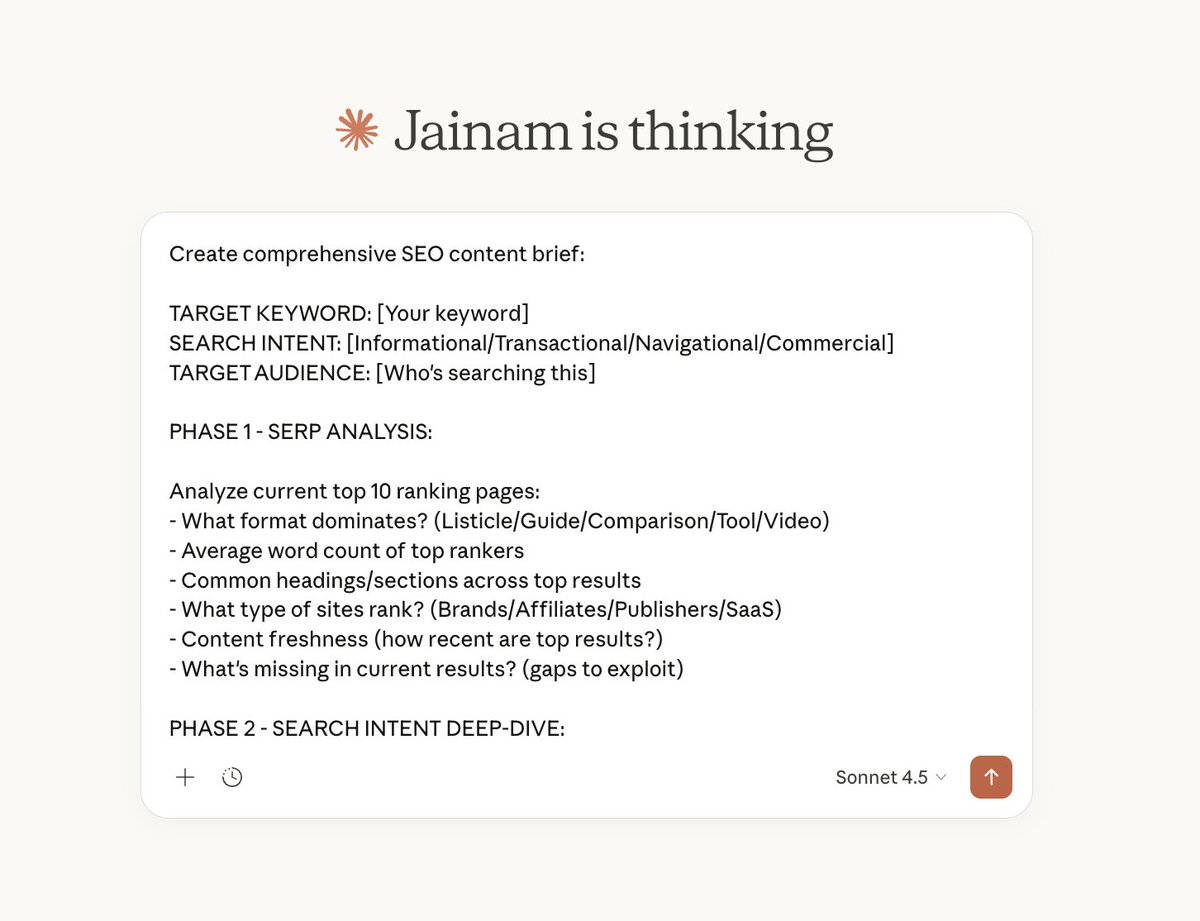
My team warned me not to share this publicly. But I'm going to share this Claude prompt that killed my $800/mo Ahrefs subscription. It creates SEO briefs better than any tool I've tested. 39 out of 47 pieces now rank…
See the original post →What you’ll get
- Audience and intent
- Core narrative
- Evidence to use
- Recommended structure
- Questions to answer
- Writing guidance
What to provide
Bring the source material. Ancher shapes the deliverable.
Search research, customer insight, brand guidelines, product context, and supporting sources.