Personal Knowledge Management: A Simple System You Can Use
Build a personal knowledge management system around one real project: capture with context, organize sources, write a working note, and reuse what you learn.

You have saved enough articles to write the proposal. You even remember reading something that would strengthen the opening. But when you sit down to write, you start searching the web again.
TL;DR
Personal knowledge management means capturing, organizing, and reusing information for your work and learning. Build the system around one project: save sources with a reason, collect them together, write a working note, use it in a draft, and archive the finished decision. You can do this with an ordinary document; AI is optional.
You can start with one active project, one place to collect material, and one working note. This guide uses a proposal as an example, but the same approach can support study, writing, or a decision you need to make.
Start with an outcome, not an app
Choose something you already need to finish. “Learn more about marketing” is an interest. “Write a proposal for our next customer workshop” is a project with an identifiable result.
Write that result at the top of a working note. Under it, add the questions you need to answer. For the workshop proposal, those might be who it serves, what participants should leave with, and what evidence supports the format.
Now you have a reason to save—or ignore—the next article. A source belongs in the project if it helps answer one of those questions. Interesting material that does not help can stay outside the active collection.
You do not need to migrate your old notes first. Doing so turns a small writing task into an archive-cleaning project before you have tested whether the new system is useful.
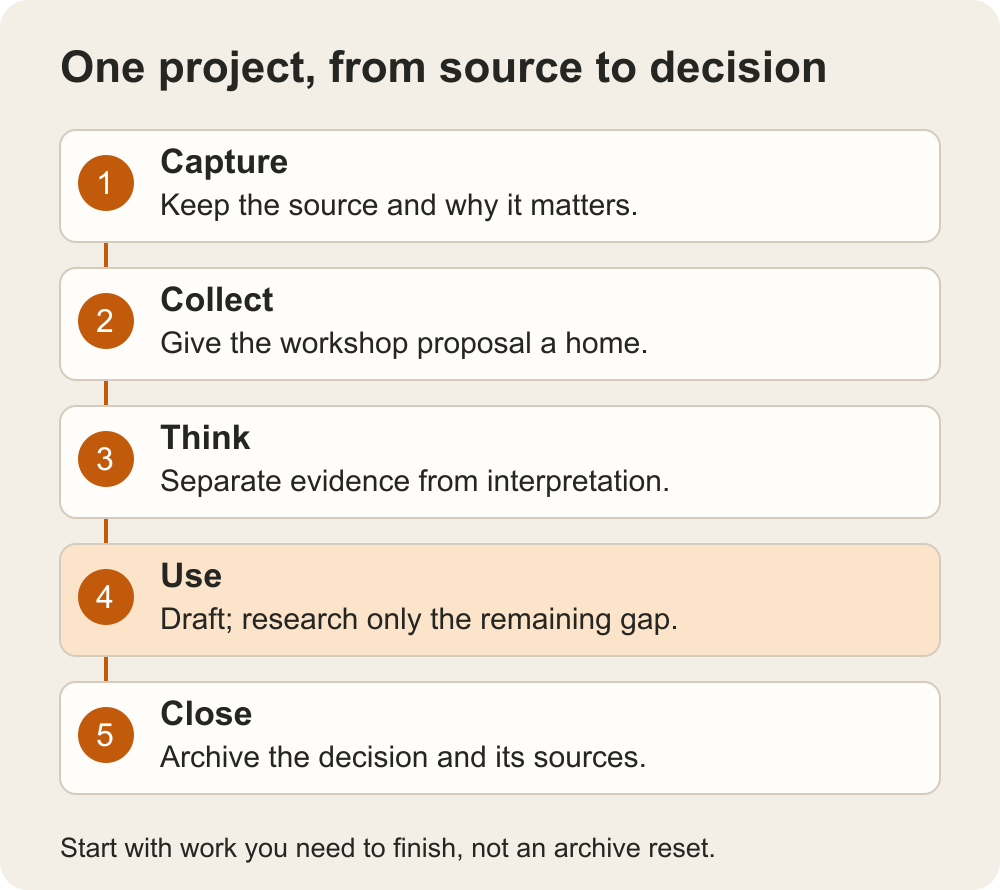
Step 1: capture the source and why it matters
A bookmark records where something is. A useful research note also records why you wanted it.
When you save a source, add a sentence in your own words. “Useful article” will not help next month. “Explains why a workshop should end with a participant-created artifact” gives your future self something to work with.
For each useful source, keep:
- Its title and original URL or file.
- The point you may want to use, with a passage or page reference when available.
- Your interpretation, clearly separate from the author’s claim.
- Any date, limitation, or context that changes how the point should be read.
Not every saved link deserves this treatment. A restaurant you may visit can remain a bookmark. Use the extra note when you expect to build an argument or decision from the material.
Step 2: give active work a small home
Put the workshop materials together under the project, even if they cover different subjects. The collection exists to help you write the proposal, not to classify everything you know about workshops.
If you need a broader organizing system, Tiago Forte’s PARA method distinguishes projects, ongoing areas of responsibility, resources, and archives. The useful distinction is between work with an outcome and material you may want to reference. You do not have to implement a large folder tree to benefit from it.
For this project, a minimal structure is enough:
| Place | Put this here | Keep out |
|---|---|---|
| Inbox | New material you have not evaluated | A second permanent archive |
| Workshop proposal | Sources, questions, and the working draft | Unrelated reading |
| Reference | Material useful beyond this project | Every link you have ever saved |
| Archive | Finished project and its supporting record | Items still requiring action |
Use the same names wherever practical. If files must remain in another approved system, link to them instead of copying them into several competing versions.
Step 3: turn highlights into a working note
Highlights are useful pointers, but a page full of them still asks you to do the synthesis later. Create one note that brings the project’s questions and sources together.
Here is an illustrative structure for the workshop proposal:
Decision: What should participants produce by the end?
Evidence: Link to the relevant passages in the sources we are using.
Interpretation: Explain why those passages support this workshop format.
Open question: What do we still need to learn from prospective participants?
Next action: Ask the workshop owner to review the proposed outcome.
The example is a template, not a reported research result. Fill it with what your sources actually support. If an article describes university teaching, do not silently treat it as evidence about your customer workshops. Record the difference and decide whether the idea is still worth testing.
This is where your thinking enters the system. The note should make your reasoning easier to revisit, not hide it inside a collection of quotations.
Step 4: use the material before saving more
Draft the proposal from the working note. When you reach a gap, write down the specific missing question before searching again.
“We need more research” is hard to finish. “We do not know whether participants can complete the activity in the available time” suggests a concrete next step: test the activity or ask someone who has run a comparable session.
You may discover that a saved article is irrelevant. Remove it from the active project. That is useful progress, not evidence that the system failed. The collection is serving the work rather than asking you to preserve every early guess.
For a reading-heavy project, Ancher’s collections can hold related saved notes and provide context for a draft. You can also do this in a document with source links; choose the tool based on how much material you need to work through.
If you use AI, ask it to distinguish evidence, interpretation, and missing information. Then check the result yourself. Keep the source alongside any claim that would change the reader’s decision. A summary is a starting point for review, not a substitute for it.
Step 5: close the project without losing the lesson
Once the proposal is accepted or rejected, save the final version and a short note on the decision. Move the inactive collection out of the active workspace.
Record what someone would need to understand the result later: which version was approved, why the approach was chosen, and what remained uncertain. Do not label an untested assumption as a lesson learned simply because the project has ended.
A reusable insight can go into your reference material with a link back to the original project. For example, you might keep the workshop planning checklist after it has been useful. You do not need to duplicate every attachment to preserve that value.
What usually makes the system harder than it needs to be?
Too much structure before real use. If you spend more time deciding where a note belongs than using it, reduce the number of places you can put it. A project collection and a searchable reference area may be enough.
Saving without a reason. When the inbox becomes a reading obligation, stop importing everything. Keep material tied to an active question and deliberately discard what no longer matters.
Summaries with no source. A concise note is convenient until you need to check the qualification it left out. Keep a path back to the original.
A system that only gets attention during a reset. Revisit your active collection when you resume the project. Remove stale questions and add the next action while the context is still fresh. There is no required daily ritual or perfect maintenance schedule.
A useful system gets you back to the proposal
Personal knowledge management works when the material you saved helps you finish the work in front of you. You should be able to reopen the workshop project, see the decision it supports, and continue writing without reconstructing everything from memory.
Start with that small loop: save with a reason, collect around an outcome, write a working note, use it, and close the project. Add complexity only when a repeated problem calls for it. The archive can grow later; the proposal needs to get written now.
Ancher
Start with one project
Save the material you need now and use it to prepare your next brief, proposal, or post.
Try AncherFAQ
Frequently Asked Questions
Do I need a special app for personal knowledge management?
No. A document, folder, or existing notes app can be enough. Consider a different tool when capture, retrieval, or working across several sources becomes a repeated obstacle.
Should I organize my old notes before starting?
Not necessarily. Start with an active project and bring older material into it only when useful. This lets you test the workflow without making archive cleanup a prerequisite.
How often should I review my notes?
Return to active notes when you resume the work they support. Review the inbox when it starts hiding important material. Use a schedule that solves an actual problem rather than maintaining a ritual for its own sake.